“Die Oesterreichischen Niederlande vermehrt”- Copper Engraving
c.1724SGD 850
Visual Features
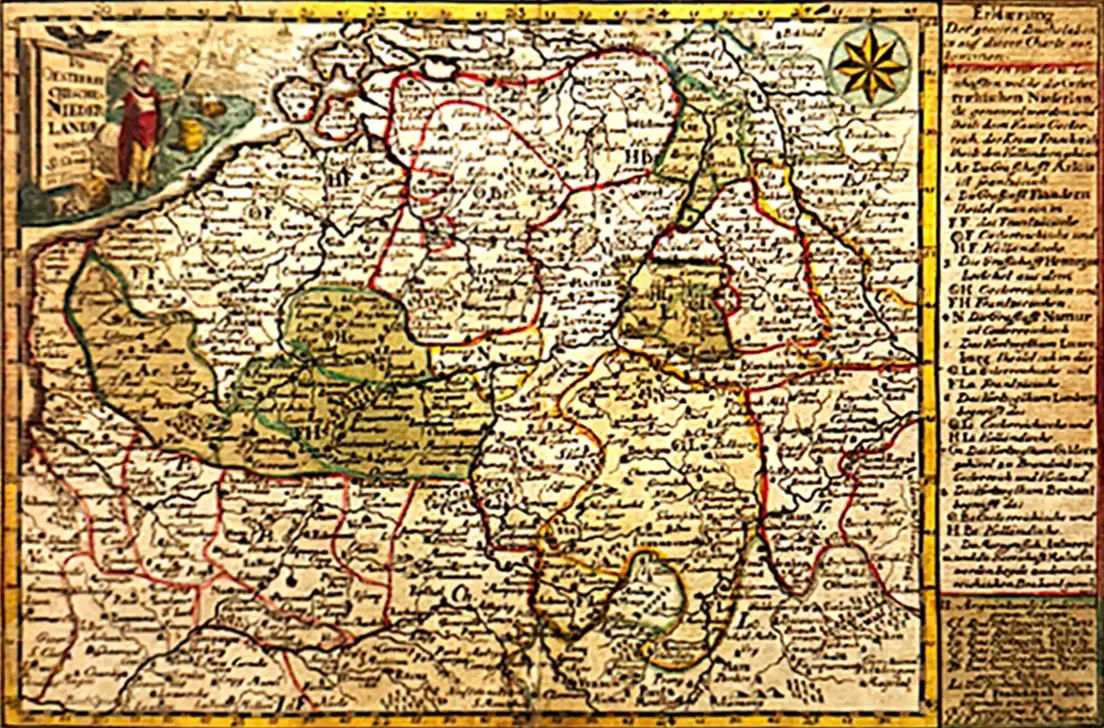
The map is richly coloured, hand-drawn boundary lines demarcating provinces and principalities of the Austrian Netherlands and territories in adjacent regions governed or influenced during the early modern period. It corresponds to present-day Belgium, Luxembourg, parts of the Netherlands, France, and Germany. The upper left corner displays an ornate cartouche with a classical figure and maritime symbols, indicating the Austrian connection. A compass rose is located at the top right, helping orient the map.
Geographic Scope
It shows rivers, towns, and cities in regions historically part of the Austrian Netherlands before the end of the 18th century, including Flanders, Brabant, Hainaut, Namur, Limburg, and Luxembourg. Significant cities such as Ghent, Brussels, Antwerp, and Liege are visible that formed part of major trade and administrative networks.
Legend and Abbreviations
The extensive legend to the right deciphers the abbreviations for regions (e.g., F.L. for Flandern, Br. for Brabant), and provides brief historical context or administrative notes about each political entity. Some notes reference territorial changes, ruling houses, reflecting the fragmented and contested nature of rule in this area during the 18th century.
Historical Context
This map reflects the complex patchwork of sovereignties and jurisdictions that characterized the region under Habsburg rule. Such maps were used both by administrators and merchants, highlighting political boundaries and commercial routes vital to the area’s role as a crossroads in Europe.
Decorative Elements
Typical of early modern cartography, the upper left features allegorical figures, barrels and ships, signifying commerce and maritime activity, and often symbolizing prosperity or political claims over the region. This map is a detailed and decorative historical document offering insights into early modern European political geography and cartographic practice.
Christoph Weigel 1724 (German)-Copper engraving
H: 33cm W: 41.5cm
H: 13" W: 16 1/2"