LES XVII PROVINCES DES PAYS-BAS-Copper Engraving
c.1774SGD 475
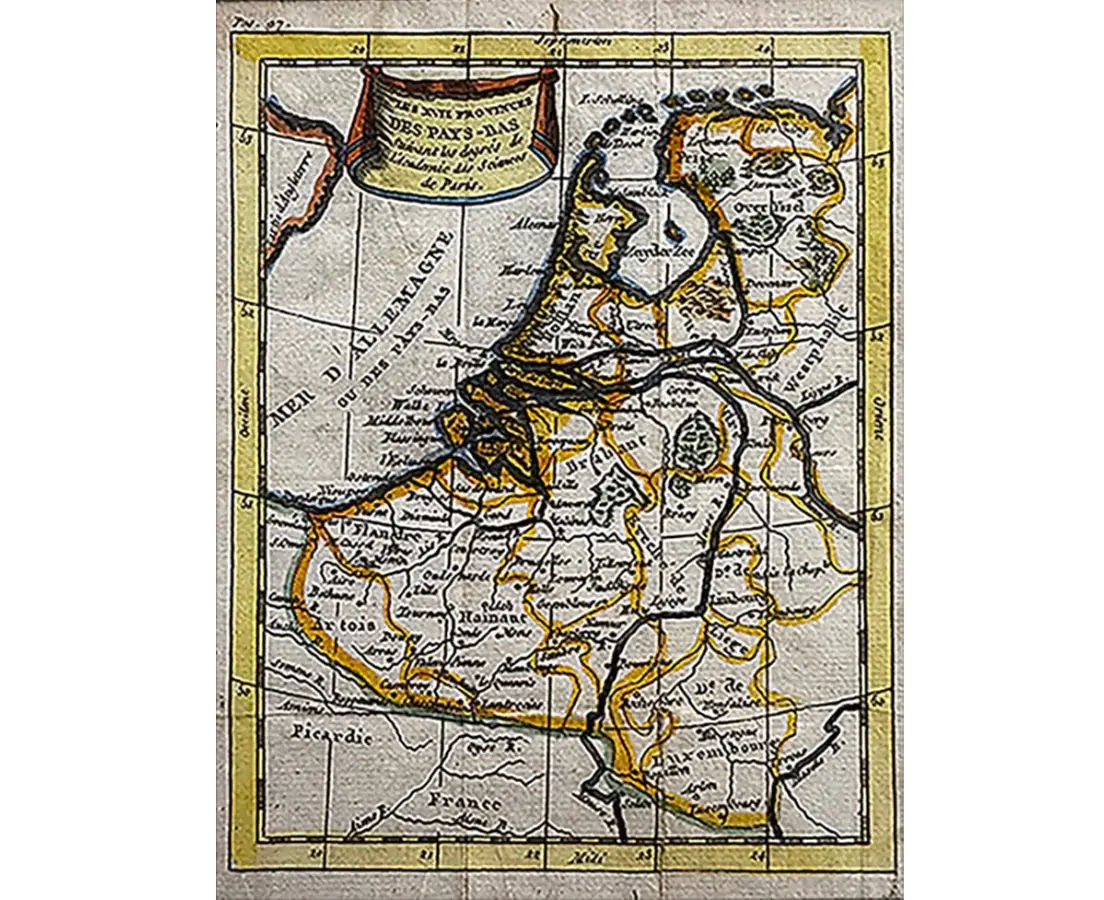
LES XVII PROVINCES DES PAYS-BAS Suivant les degrés de l’Académie des Sciences de Paris(The Seventeen Provinces of the Netherlands According to the Degrees of the Academy of Sciences of Paris
Pierre Du Val-1774 C. (French geographer)
The map created by “suivant les degrés de l’Académie des Sciences de Paris” follows the geographical calculations of the Paris Academy of Sciences. The boundaries outlined in yellow trace important political and territorial divisions of the era, including regions that correspond today to Belgium, the Netherlands, Luxembourg, and parts of northern France.
Key Features
The map is hand-coloured, emphasizing territorial borders and regions with yellow outlines. The “MER D’ALLEMAGNE OU DES PAYS-BAS” (Sea of Germany or of the Netherlands) denotes the North Sea area. Numerous historical place names are visible, such as “Flandre,” “Artois,” “Brabant,” “Hainaut,” “Luxembourg,” and prominent towns like “Bruxelles,” “Anvers,” “Amsterdam,” and “Rotterdam.”
Additional features include major rivers, such as the “Oyse,” “Aime,” and “Lippe,” and notable geographic landmarks like the “Zuyder Zee” (Zuiderzee). The map uses French as its primary language, reflecting the scholarly or administrative origin typical of Enlightenment-era cartographic works.
Historical Context
The Seventeen Provinces were a group of states in the Low Countries that were unified under the rule of the Habsburgs in the 16th century. The map predates the later divisions between Belgium, the Netherlands, and Luxembourg, showing a unified region recognized in early modern European history. The use of detailed place names and administrative borders is characteristic of maps intended for academic or official reference during the Enlightenment period.
Visual Style
Decorative cartouche displays the map title at the top featuring latitude and longitude lines framing the map, signalling scientific influence in its creation. Engraved and hand-coloured features contribute to its antique aesthetic, typical of 18th-century European wall maps.
The map is professionally framed using high quality and acid free materials.
Paris
Copper Engraving
H: 34cm W: 30cm
H: 13 ¼” W: 11 ¾”